// UPDATE · 2026-10-17 · ENGINE 3.13.0
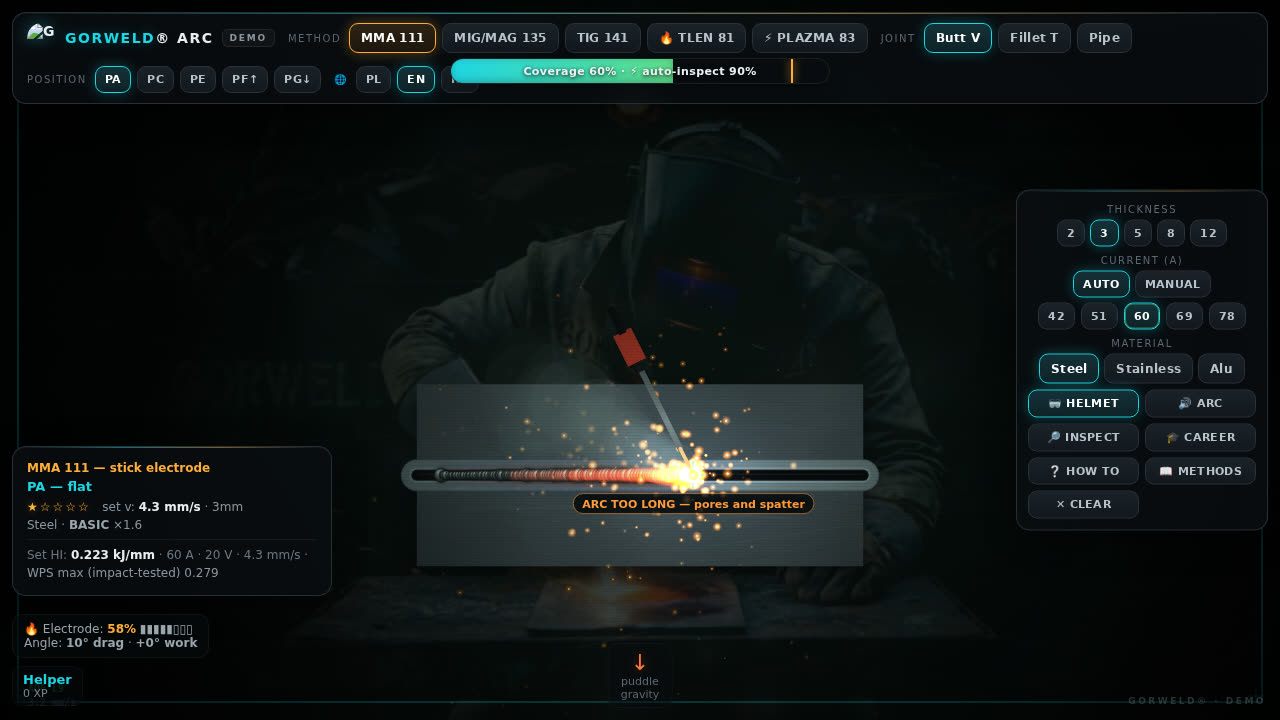
Vertical welds have a direction now. PF is welded bottom to top, PG top to bottom. Run a PF bead downhill (or PG uphill) and the inspection rejects it as not per WPS.
The bead and the puddle also look different going up and going down, and the guide line shows where to start. Runs recorded before 3.13.0 score the same as before.
// UPDATE · 2026-10-16 · ENGINE 3.12.0
Your electrode stays in the holder. Pick Ø 2.5 and the next bead is welded with 2.5 too, until you change it.
The game no longer swaps to the typical size on its own; it only tells you which one is typical (★). Runs recorded before 3.12.0 score the same as before.
// UPDATE · 2026-10-16 · ENGINE 3.11.0
The arc stays in the joint. You strike, weld and lay metal only in the groove and along the bevel. Before,
dragging the electrode across the plate laid a carpet of weld anywhere on it. Strike on the bare plate and the arc
won't light; drift off the groove and it goes out. Good runs score exactly as before. Runs recorded before 3.11.0 score the same as before.
// UPDATE · 2026-10-16 · ENGINE 3.10.0
Electrodes. Stick (MMA): you pick the electrode for every bead — Ø 2.0 / 2.5 / 3.2 / 4.0, the typical one
is marked ★. Current comes from the electrode (2.5 ≈ 80 A, 3.2 ≈ 115 A, 4.0 ≈ 160 A, less out of position) and the
arc length is set by its diameter. Too thick on the root burns through; too thick on the cap means more heat input,
so on steel you travel faster or it fails; too thin gives a cold, narrow bead. Heat input is now checked bead by bead.
Manual current can be changed between beads. Runs recorded before 3.10.0 score the same as before.
// UPDATE · 2026-10-16 · ENGINE 3.9.0
Plate drawn to scale. One millimetre scale for every thickness: 3 mm is 3 mm, 5 mm is 5 mm, 12 mm is
four times 3 mm — plate edge, gap, V-bevel and the bead you lay. Before, each thickness had its own scale and
5 mm looked almost like 3 mm. The cross-section lens keeps the same scale too. Runs recorded before 3.9.0 score the same as before.
// UPDATE · 2026-10-16 · ENGINE 3.8.0
Bead plan the way a welder runs it. Butt joints and pipe: a fast stringer root, then one weave fill
and one weave cap — in every position and with every process. 12 mm is now three passes, not ten.
The bead is drawn as one continuous face with tight ripples instead of a string of overlapping dots.
PG (vertical down) goes up to 5 mm — thicker plate is welded PF. Runs recorded before 3.8.0 score the same as before.
// UPDATE · 2026-10-14 · ENGINE 3.7.0
Real bead sequence. Every thickness, position and process now has its own weld plan: 12 mm stick in PC
is 10 beads (root, two fill layers, a four-bead cap), PF is a few weave beads, MAG needs one fill layer less,
TIG one more. Each bead has its own lane across the groove. The cap has to cover both bevel edges,
neighbouring beads have to fuse, and with stick you chip the slag (key C) before the next bead — or it stays in
the weld as an inclusion. Plate thickness, bevel and the cross-section on the plate end are drawn to scale,
with a magnified section next to the seam and a macro section in the report.
Runs recorded before 3.7.0 score the same as before.
// UPDATE · 2026-10-07 · ENGINE 3.6.0
Racing the seam no longer passes. Run a pass faster than 1.5× the WPS travel speed
(stainless and aluminium: a bit less) and the weld is rejected — underfilled groove and lack of sidewall
fusion, just like on a real coupon. Points stay as they were; it's an acceptance rule, not a penalty.
Runs recorded before 3.6.0 score the same as before.
☝ Arc above your finger. On a phone the arc now burns a little above your fingertip, so you can
see the gap you are welding. Switch it off in ⚙️ if you prefer the old feel.
// UPDATE · 2026-10-05 · ENGINE 3.5.0
BATTLE WELD — weld duels on gorweldarc.com. Send a link, both welders get the same task,
the server replays both runs through the same engine and calls the verdict. No account needed.
The plate ends where it ends. Run past the end of a straight seam and the arc goes out —
no more bead laid in the air. Pipes and cutting unchanged.
Scoring unchanged — old runs score the same.
Workshop music. Optional lo-fi track, off by default, ducks while you weld.
// UPDATE · 2026-09-02 · ENGINE 3.4.0
The whole heat-input equation is now in your hands. Current on the knob —
AUTO follows
the WPS,
MANUAL holds the amps you set. Arc length on the two mouse buttons; press both at once
to break the arc on purpose. Electrode angle on the keyboard:
WS push ↔ drag,
AD work angle.
TIG has a second hand. Space dips the filler rod — your rhythm, not a timer.
Drift off the joint line and the penalty now grows with the distance instead of jumping in one step.
Heat input is a code limit, not a preference. On impact-tested steel, going over the WPS
maximum rejects the weld — and the live hint tells you while you can still fix it: shorten the arc
first, then speed up.
Old runs still score the same, to the bit.